Showing posts with label pinnacle. Show all posts
Monday, December 3, 2012
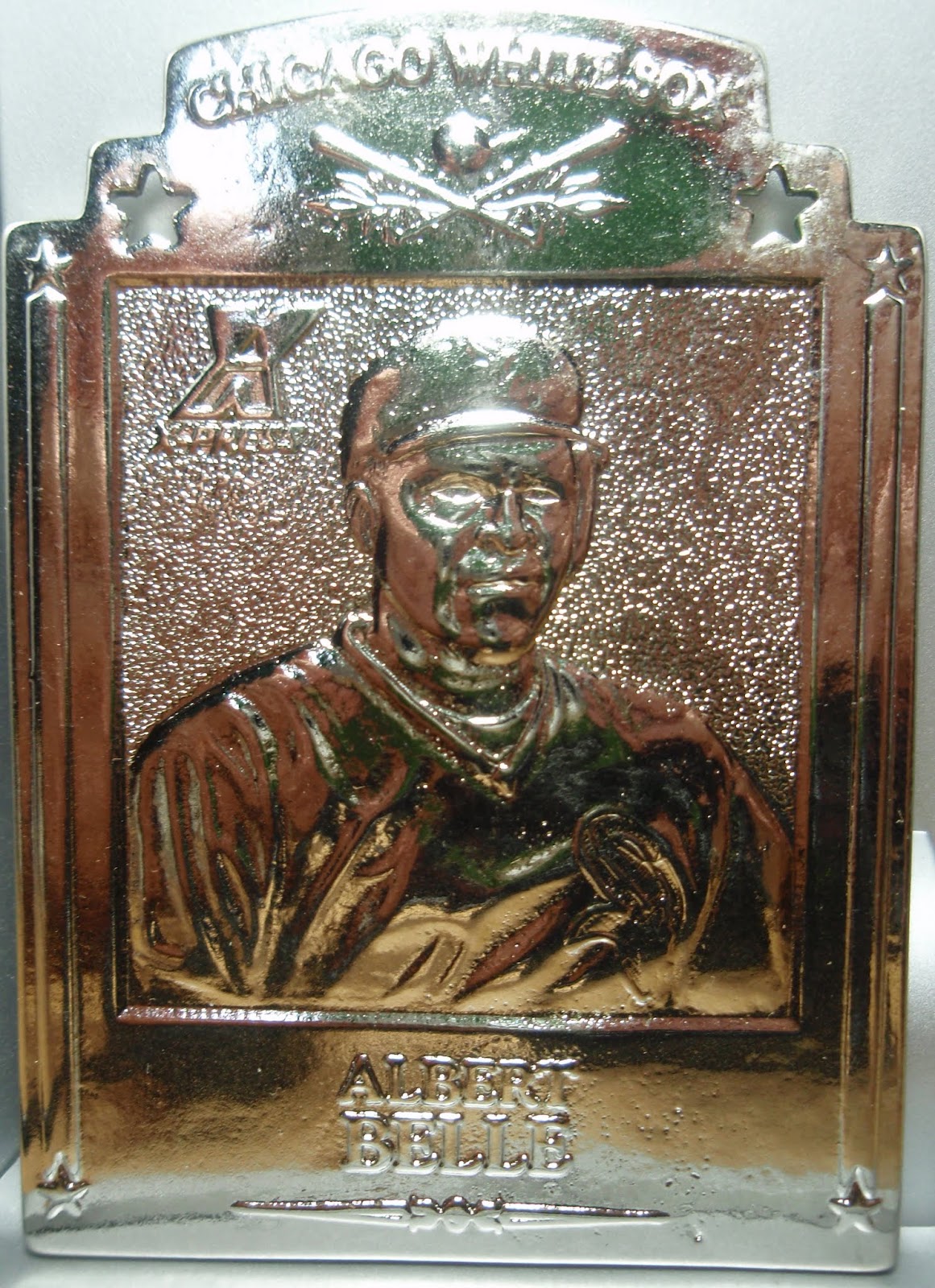
1997 Pinnacle X-Press Metal Works Gold
Set Size: 20 cards
Design Notes: This is the gold-plated parallel to the solid bronze Metal Works insert set. Like the silver version, the card is really bright and shiny, with pretty good detail to the player photo (though it may not exactly be realistic). The cards are serial-numbered on the back, at the top.
Parallels and Similars: As mentioned, the "regular" insert set is solid bronze, and a silver-plated version also exists.
Distribution: Redemption cards for the gold-plated parallels were inserted into packs at a rate of 1:950 and home plate master deck boxes at a rate of 1:108. These are the most-limited of all card sets inserted into Pinnacle X-Press.
Thoughts: The gold plating is awesome. It looks and feels like you robbed Fort Knox of a gold bar that happens to be the same size and design as a baseball card. If they weren't so tough to find and thus expensive, this would be the ultimate set to complete. The bronze coins are easier to view as far as detail, but the gold cards are really beautiful. Besides, not many people can say they have baseball cards made of gold. And no, those ones inserted in WalMart repacks don't count. But those solid-gold cards issued by Topps this year does. I'd love to get my hands on one of those!
Sunday, December 2, 2012
1997 Pinnacle X-Press Metal Works Silver
Set Size: 20 cards
Design Notes: Identical in design to the (solid) bronze version I showed yesterday, this parallel is silver-plated. The surface is very shiny, almost mirror-like (especially on the flatter back) and is serial numbered on the back at the very top. The "cards" are very thick and heavy.
Parallels and Similars: An unnumbered bronze base version and a gold-plated parallel set also exist.
Distribution: Each silver parallel card is serial-numbered to 400. They were acquired via redemption cards (no longer valid). Apparently you knew whether you were receiving a silver or gold card, but you wouldn't know which player until you received your redeemed Metal Works card. The odds of receiving a silver Metal Works redemption card in packs was 1:470, and in master deck "home plate" boxes 1:54.
Thoughts: The metal cards are really heavy and thus difficult to store, ship, and transport (a full set of 20 would seriously weigh down a box). However, they look really great and, while not unique, they stand out from other inserts. The bronze cards are the best-looking because they have a more matte finish, making it easier to see detail. But holding a silver or gold card feels like you're holding a pure silver or gold brick and it looks much more valuable. I'm glad to have a silver card and gold card in my collection, but I prefer the bronze for building a complete set.
Saturday, December 1, 2012
1997 Pinnacle X-Press Metal Works Bronze
Set Size: 20 cards
Design Notes: The cards are heavy bronze-colored metal with relief images of the player. A crossed pair of bats with a ball is at the top, and the player's name is at thebottom. Backs have a short highlight for the player.
Parallels and Similars: Gold and silver parallels exist and are easy to identify by color.
Distribution: One card was included in each home plate box. Exchange cards for silver and gold sets were randomly inserted but are no longer valid.
Thoughts: Once again, Pinnacle created a gimmick set that I really enjoy. These cards are pretty tough to find and usually overpriced - or maybe collectors just find them more valuable. I'd like to put a set together and I have a few cards already. Poor Jeff Bagwell looks like a zombie on his card.
Friday, November 30, 2012
1997 Pinnacle Inside Dueling Dugouts
Set Size: 20 cards
Design Notes: The fronts and backs are very similar, with each side featuring one player from a different team. A wheel on one side of the card can be spun to compare a few statistical categories between the two players on a year-by-year basis. The players' names appear across the top in gold foil, and their team logos are in the lower right corner.
Parallels and Similars: None known. I'm not sure if there has ever been another card set that has the wheel feature.
Distribution: Cards were inserted at a rate of 1:23 packs (or cans, since this set was distributed in cans).
Thoughts: I really like the gimmick they used in this set. In fact, it would be kind of neat to see this tried on a full set (probably designed for kids, and with a smaller checklist). You can't do these as inserts since they're easily found out due to the hub for the wheel.
Thursday, November 29, 2012
1996 Zenith Diamond Club Real Diamond
Design Notes: A foil border in the shape of a diamond surrounds the player's photo, with the Zenith logo in an upper corner and a large portion of the bottom devoted to the set name and player's name. In the real diamond version, a small diamond is mounted at the base of the diamond. The backs contain a sepia photo of a baseball field in the background, with a player photo and short highlight paragraph.
Parallels and Similars: The regular version uses Pinnacle's Dufex technology, but there is no diamond.
Distribution: Regular cards were inserted one per box, and cards with real diamonds were found one in every 350 packs.
Thoughts: Pinnacle Brands tried a whole bunch of "gimmicky" ideas in the 1990s, including what I believe is the first card to contain an embedded gem. The actual diamond is pretty small and unimpressive, but the card is quite rare for its time. Actually, the diamond sticks out from the surface of the card a bit. I wonder if people pulling these from packs in 1996 were upset that the card preceding the diamond card most likely had a small dent in the back. Did it damage multiple cards? Or was there a filler card inserted to fix this? In addition to probably being the first embedded-gem card, it has to be one of the first "manu-relic" cards too!
Sunday, December 11, 2011
1998 Pinnacle Performers Swing for the Fences
Set size: 51 cards (50 cards + 1 exchange card)
Front Design: The front of the card contains a background with several lightly-shaded numbers, over which his cut-out photo appears. His name runs up the left side, the Pinnacle Performers logo is at the top, and the Swing for the Fences logo is at the bottom.
Back Design: The back has a card number in the upper-left and the game rules.
Parallels and Similars: No similar cards, though a similar contest was run the prior year in Pinnacle products. There are home run point cards that go along with this contest.
Distribution: These player cards were inserted 1:2 packs of Pinnacle Performers.
Thoughts: There were no winners in this contest, as Pinnacle went bankrupt before redemptions could occur. The exchange card would have provided the recipient with an autographed Juan Gonzalez baseball. None of the upgraded cards were released. As for the contest, there were similar programs done in the 1990s (including the Crash The Game contests run through Upper Deck's Collector's Choice line). It would be fun to see Topps do a contest like this instead of simple wrapper redemption programs.
Wednesday, November 30, 2011
1997 New Pinnacle Spellbound
Set size: 50 cards, with each player between 4 and 7 cards
Front Design: A swirling etched-foil design from the center of the card is covered by a letter from the player's name or nickname, which is outlined in gold foil and contains a color photo of the player. The player's name is at the bottom in gold foil, beneath the name of the set and the letters for that player in white. The position of the letter on the card is highlighted in yellow. Gold foil in the middle of the vertical borders spells out the word "SPELLBOUND" when the player's cards are placed in order.
Back Design: A grey swirling background copying the front design is behind a rectangular box with a color photo; the card number and set name is above, and an oval box at the bottom of the photo identifies the location of the letter.
Parallels and Similars: There are additional Spellbound sets in future issues, including a 1997 racing set.
Distribution: Cards were inserted 1:19 packs of New Pinnacle.
Thoughts: This concept would be taken several steps further in the future with the Letterman patch cards, and depending on your tastes, this version could be much better. It's less expensive, if you can locate the cards for your favorite player, though cards for players like Cal Ripken book as high as $15 each. The micro-etched foil screams late-90's insert gaudiness, and a series of these in a matted frame would look great on the wall.
Friday, September 30, 2011
1997 Denny's Holograms (Pinnacle) Alex Rodriguez
Set size: 30 cards
Front Design: The cards use Sportflics technology on the front, featuring a full-bleed motion photo with a white band across the bottom containing the Denny's logo, player name, and team name. The 1997 Pinnacle logo appears at the top.
Back Design: The left half of the back has the player's vitals, career highlights, and prior year and career statistics over a baseball background. The right half of the card has a hologram portrait of the player.
Parallels and Similars: None.
Distribution: Denny's patrons could buy a card for 59 cents each when purchasing a meal and drink. Card #30, Larry Doby, was distributed exclusively in the Cleveland area and isn't considered part of the set.
Thoughts: The set contains one card from each team, plus a commemorative Jackie Robinson card and the Larry Doby commemorative card. While the Sportflics card concept never really caught on, this design makes for one of my favorite Denny's sets, second behind the 1994 issue.
Front Design: The cards use Sportflics technology on the front, featuring a full-bleed motion photo with a white band across the bottom containing the Denny's logo, player name, and team name. The 1997 Pinnacle logo appears at the top.
Back Design: The left half of the back has the player's vitals, career highlights, and prior year and career statistics over a baseball background. The right half of the card has a hologram portrait of the player.
Parallels and Similars: None.
Distribution: Denny's patrons could buy a card for 59 cents each when purchasing a meal and drink. Card #30, Larry Doby, was distributed exclusively in the Cleveland area and isn't considered part of the set.
Thoughts: The set contains one card from each team, plus a commemorative Jackie Robinson card and the Larry Doby commemorative card. While the Sportflics card concept never really caught on, this design makes for one of my favorite Denny's sets, second behind the 1994 issue.
Friday, August 12, 2011
1998 Pinnacle Museum Collection
This is post number 50! I want to thank all of my readers (the approximately 20 of you per post), because without your continued interest, I probably wouldn't keep putting so much effort into these posts. Sets like this one can be written in about 10-15 minutes, because information is readily available. However, posts like the 2009 Fan Pak Standees and 1947 Smiths Oakland Oaks take much longer. In fact, the Fan Pak and 2009 Fatheads posts have taken the longest to write out of all of them, because there is no information on them in the SC and Beckett guides, and my information has to be gathered from web postings. Thankfully, company websites still exist to make some of it easier.
I know the 1990s/early 2000s stuff isn't the most exciting to many of you, but if nothing else it introduces you to many of the sets you probably missed while you were busy chasing women and alcoholic beverages. So we continue with this one!
Set size: 100 cardsFront Design: Pinnacle applied their museum finish, an etched silver foil, to the base set in this partial parallel. The player's color photo appears in the etched format, while the Pinnacle logo appears in gold foil, as does the player's last name and position, turned sideways on the right-side border. There are several subsets in the Pinnacle set that were included in the Museum Collection set, including All-Star (shown), Rookie, Field of Vision, and Goin' Jake.
Back Design: The backs contain a PP-prefix card number over a different player photo in the upper-left; the player's name, vitals, and position appear over a black-and-white version of the front card photo in the upper left. The color photo continues, faded as a background, through career stats to the bottom of the card. Most cards contain a brief highlights biography beneath stats. The Museum Collection identification, team logo, and copyright logos and information fills the card bottom.
Parallels and Similars: This set is a partial parallel to the 200-card base Pinnacle set, and an Artist's Proof version with gold foil and a red Artist's Proof seal.
Distribution: Museum Collection cards were inserted into 1998 Pinnacle packs at a rate of one in nine packs.
Thoughts: The etched foil never really seemed to catch on. I didn't find it terribly attractive, because it took away from the high-quality photos and printing later-issue Pinnacle sets provided. It is best used in inserts. That said, these parallels provide something more to the parallel aspect than just extra gold foil stamping or different-colored borders. At only 100 cards, this isn't too difficult a parallel to complete, if you can find the cards at decent prices.
Subscribe to:
Posts (Atom)